Chapter Twenty-Two
When faith is the bedrock upon which a life is built, the loss of it, when belief crumbles to dust, reduces a man to bitter, abject desolation. Malak died in the sand, and in the sand he was reborn.
Waves crashing, the sun blinding, and the ocean a pale welcome blue, he plucked a crab from his chest and pulled yellow seaweed from matted hair, pushing himself into a seated position. Coconut palms stretched toward the sea along a pristine white beach. At his back a steep mountain lush with green jungle rose toward the cloudless sky. He’d never been anyplace like this before.
“Is this heaven? My reward? It looks a little lonely,” he muttered.
A seagull landed a few feet away and twittered at him. The crab scuttled along the surf line with one oversized claw, and one tiny, ridiculous one. The big claw raised like a shield.
“What do you want from me?”
The breeze,balmy and sweet, ruffled his long hair.
“Remember our last talk? I quit. I’m not doing this anymore.”
The palms rustled and the waves broke upon the reef line and lapped the shore, a steady rhythm of foam and clear water, more than a whisper, less than a conversation. Peaceful, serene.
Malak was not in the mood. He thought about the family he’d lost, the screams of children still echoing in his heart. The demon he’d faced, a thing which he never known walked the earth until he’d felt its unholy power. To him it was days ago, though he had no idea how much time had elapsed between Baghdad and wherever this was. Whenever he was.
His existence was unfair, he decided. Every life he’d lived felt futile, as did life itself. The friends he’d seen die, the blood he’d spilled with a blade… there seemed to be no sense to any of it, within the context of a loving, living God. Especially given that reality.
While he had experienced great peace, the times of turmoil and war overshadowed this, and he saw that both he and mankind were no closer to figuring things out than they were centuries ago.
The crab skittered toward a hole in the sand, and the bird hopped over to the crab and skewered it.
The crab does not pity itself, even as it dies, any more than the bird gloats over the killing and the meal. Men are different. Perhaps emotions only make living harder. For the crab does not expect to live any more than the bird believes it will eat, and the fact that these desires conflict keeps neither awake at night. If the crab assumed he’d be protected, living the crab-life, surrounded by hungry birds, yet confident in his continued prosperity, he would get angry when that beak pierced his shell.
“What’s the point? Clearly, there isn’t one. When I believe, you destroy. You are God. I can’t deny that you exist. Not after the things I’ve seen. But you are not what you should be. You’re a cheat in the marketplace, full of sunshine promises and whitewashed smiles, who then vanishes when it turns out you sold a lie, a cracked jar. You have no integrity. That you exist does not make me love you.”
He knew that these words were the worst sort of blasphemy, and it his lips burned a bit with the speaking of them and his guts tightened up, his body rebelling against his mind.
He walked along the beach, letting the water slide over bare feet, feeling the sand between his toes and the warm sun on his neck. He walked for perhaps an hour or two, and wound up where he started, circling back to his first footprints. The bird cocked its head at him and laughed in the way that birds sometimes do.
He was on an island.
Malak plopped down in the sand and watched the sun slide below the ocean, streaks of pink and yellow and purple painted upon the vast sky, and the face of the waters shimmering orange against the dancing white of the breakers and the deepening blue of the sea. The day dying, the night born.
He did not move, watching the first stars appear, punching through both light and darkness, becoming a wondrous myriad of diamonds strung melting into the sea. All the while, the waves hushed and frothed, luminescent and soothing.
He decided he would explore the interior in the morning, and that if he wanted to quit living and dying for both God and man, this would be the perfect place to do it.
That is exactly what he did.
He would come to call the island “The Rock,” and although he couldn’t know it then, it would become a place of solitude and wonder and joy. It would be a refuge, the only place he was born again more than once; often as he was dying, he prayed he would wake up there. It didn’t happen often enough for his liking, but when it did, he’d feel the sun on his face and the thirst in his soul and hear the music of the ocean and he would smile.
It took time to figure this out. Malak was hard-headed, and immortality proved no solution to being stubborn.
Water was a problem, and it was only through dumb luck that he figured out that coconuts held life-giving water within their hard shells. During a storm, a green one fell next to him, and he heard the liquid inside. After wasting the precious liquid on the first few attempts, he learned how to remove the outer husk and pierce the shell within, drinking heartily. He also learned to drink from plants after a hard rain, and started collecting his coconut shells to gather water during the rainy season. Despite being stubborn, Malak was smart and tough and adaptable
He ate fish every day, because the flesh contained water. At first he speared them, and as time went on, he learned to dig alcoves reinforced by coral and lava rock, letting the tide bring the fish in, where they would be stranded after it receded. He added nets formed with vines from the jungle to make this more effective. There were abundant fruit trees on the island, as well, and when it did not rain enough, these saved his life more than once. The island provided.
He was gifted and cursed with what would later be known as a didactic memory. He forgot nothing. He could recall the taste of food he’d eaten in the Ludus or Lisdenfrane on any given day at a specific meal, along with the ribald or Godly conversations which ensued. The more alone Malak was, the more he retreated into the past, finding comfort and solace with friends long dead. Hearing their cries, at the end. That was the thing.
As good as his memory was, these conversations were all one-sided, more akin to eavesdropping. He could not speak to his comrades any more than they could talk to him on this deserted island. The moments were what they were, unaltered and done, and even though Malak wished to speak into the past, he could not. What was done was done.
He exhausted these memories, and that soul-shrinking loneliness came back. It was a poverty of the soul.
He needed to get off the island because he was going insane. Also, he was bored. He’d been there for more rainy seasons than he could count. At least twenty years. He had every cause to believe that the easiest way off the island was to die.
At dawn, after a long night of dead conversation, he set out into the ocean.
He swam beyond the breakers, the waves smashing into the coral below, his blood blooming in the clear water, warm in the way that Lisdenfrane was not, wild and teeming with life and death.
The first time, he made it beyond the reef. He swam until he was exhausted, swept by the current out into the open ocean. He choked on salt water and sputtered and stroked. Things stung and nibbled at his extremities. The moon rose high and bright and he was far from land and man. He rolled onto his back while a thunderstorm crashed a few miles away, lightning arcing from horizon to horizon, white and ragged, waves building, his body carried up and down, as alone as any man can ever be.
“Here I am! Kill me! You don’t care, so let’s get it over with!” He gulped a cresting wave, the water stinging his eyes.
The first shark took his right leg above the knee with one bite. It felt like a hard shove, followed by tingling and pain and ironic, gulping laughter. The next shark chomped him in the torso and took him down for a while, a plunge into the dark, where his ears hurt and his lungs burned and his guts were on fire below the sea, and Malak decided that there were better ways to die.
He felt the same sun, heard familiar lazy waves, and saw the same damn bird making angry tracks in the sand when he opened his eyes again.
“Really?”
He experimented with ways to kill himself for a season. Drowning, starvation, fire, and the ever faithful sharks. None of it worked. He wound up back on the beach.
And so began the conversation that mattered. The one he was meant to have.


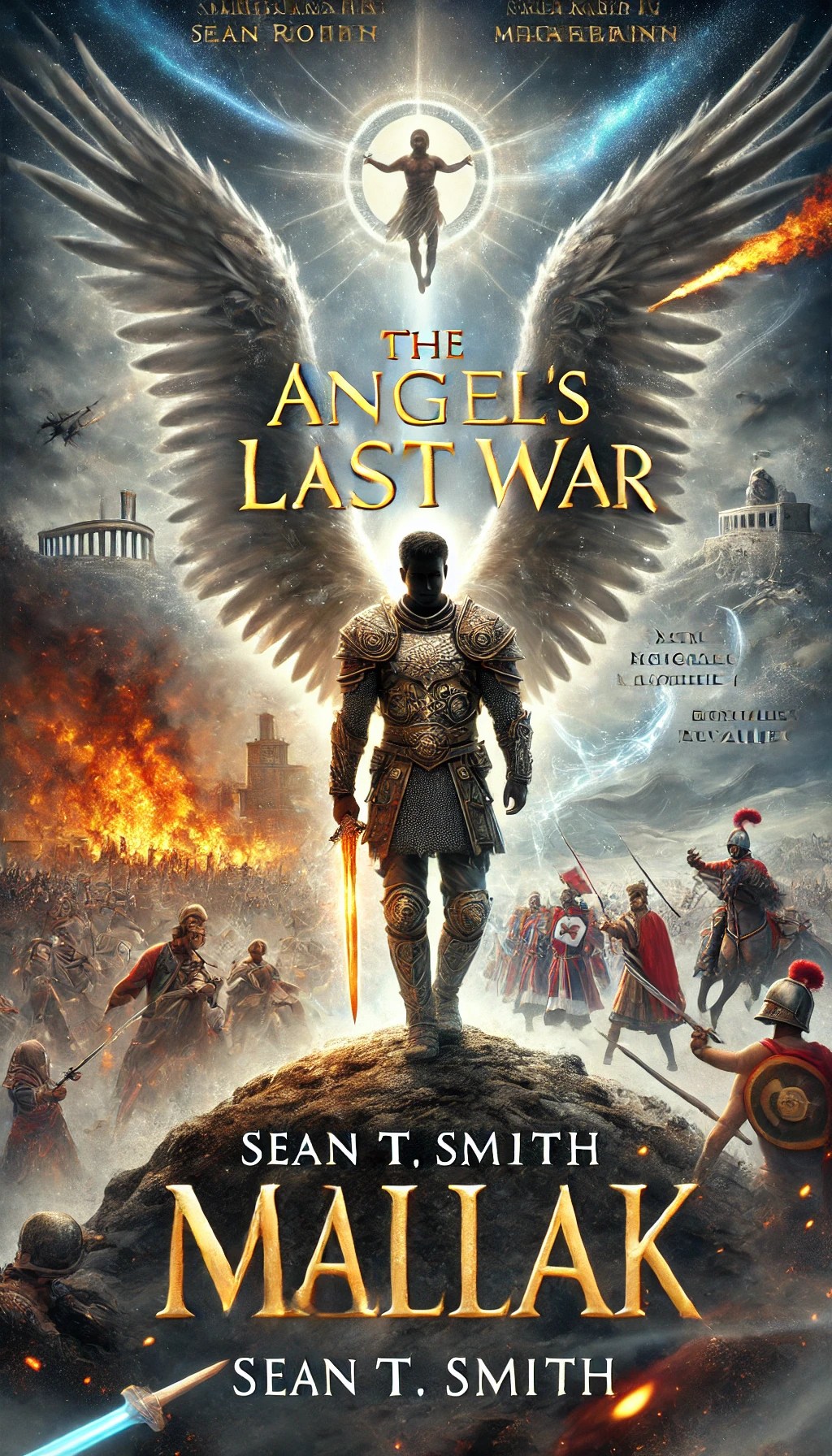
 2016 should be a very interesting year for me! I’ll have my first book in bookstores on March 22 with the release of Tears of Abraham, a novel about the next American Civil War. I hope to generate some press and buzz with this book, as the nation continues to rip itself apart with political vitriol. I hope people read the book and come away with the feeling that we as a nation are better than what we’ve turned into.
 Author Sean T. Smith