Inside the Idea: A Glimpse Into A Crusty Writer’s Mind

A Fascination With History

When I was a kid I was blessed to have parents who encouraged my interest in history. My folks took me to countless forts, battlefields and museums. There is something special about seeing things in person rather than just hearing about them in school. I remember standing on the battlefield at Antietam when I was twelve and trying to imagine what those boys who had died there might have felt as they faced a charge. I recall closing my eyes and seeing the flash of bayonets and there was the smell of gunpowder and the screams of the wounded and dying. Inside the farmhouse there were pictures of dead soldiers sprawled over the very ground where I stood.

I visited many revolutionary war battlefields and was privileged to explore the Smithsonian. History came alive for me. I recall being blown away by the fact that I was looking at George Washington’s sword, the one he had worn into battle. And then seeing the sword that he accepted in surrender from General Cornwallis at Yorktown. The connection between where we had come from as a nation and where we’d ended up seemed to be a tangible thing that mostly made sense to me. It gave me a deep sense of appreciation for those who’d sacrificed everything for America.

During those same years, I was devouring science fiction like a starving man at a Golden Corral, eagerly immersing myself in futuristic worlds and complex narratives. The imaginative universes created by authors like Asimov, Heinlein, and Herbert made a huge impact on me, each story weaving intricate themes of humanity, technology, and moral dilemmas that challenged my perspectives. I found myself pondering the ethical implications of artificial intelligence in Asimov’s tales, the gritty social commentary within Heinlein’s works, and the rich, intricate political landscapes of Herbert’s Dune series. Each book opened a new door to possibilities, fueling my curiosity about the universe and igniting a passion for storytelling that has stayed with me ever since.

I think my books reflect my love of history expressed through the “what if?” lens of science fiction.

A Fresh Twist on Old Themes

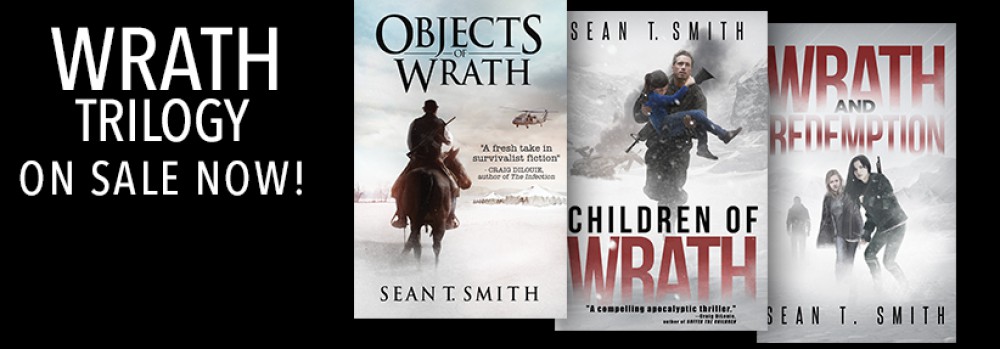
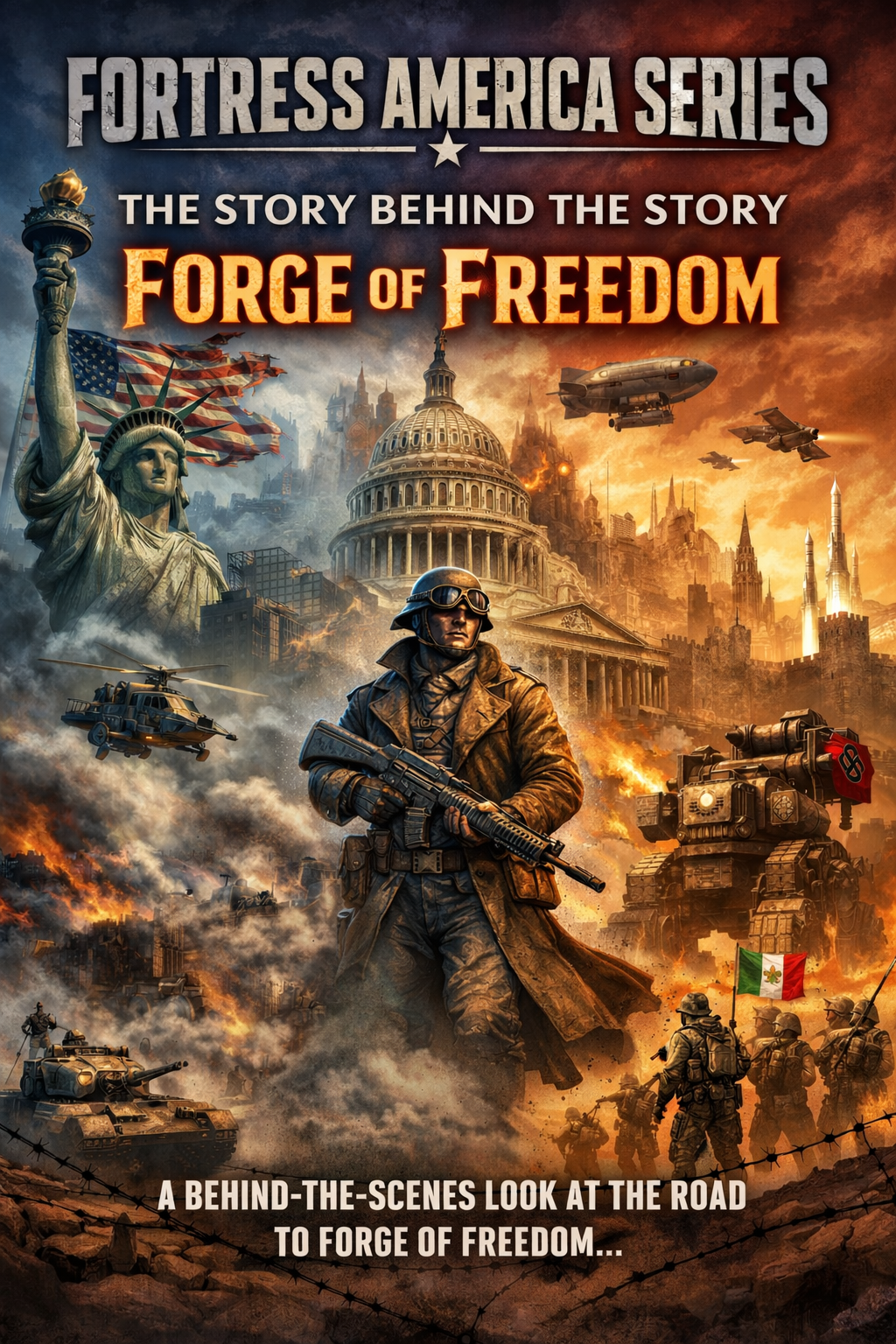
With the Wrath series, I explored what the aftermath of World War Three might look like. In Tears of Abraham I delved into the horrific destruction that a second Civil War would bring to the country. The Fortress America will ultimately combine those two Themes.

I am hard at work on the next novel in the series, Anvil of War. This one is centered around the defense of Taiwan against the Chinese invasion, and it picks up right after the events of Forge of Freedom. The third novel is as yet untitled but will take place probably twenty-five years in the future and will revolve a second American Revolution in the wake of the Bates authoritarian presidency.

Some Tidbits

The title Forge of Freedom was my publishers’ idea. The brothers John and Dean must endure tremendous pressure from their father. The title is meant to evoke that heat and pressure and that hardened resolve.

Fortress America is the name of a military board game I used to play with my old buddy Arthur back in high school. The premise of the game is that the United States has become extremely isolationist and is invaded. As of this writing, the global opinion of the United States has plummeted. 74% of people in Germany and 65% in the UK and Canada have unfavorable opinions of the United States. This, following the Greenland embarrassment, when Germany and France sent troops to Greenland to defend against America. If something does not change, NATO will fall apart.

I had planned and written the assassination plot line a year before Trump ran for office again. After the attempt happened, I was so discouraged by how close it felt to my novel that I quit writing.

Please leave an honest review!

I hope you enjoy my work, and will leave me an honest review on Amazon. Your thoughts and feedback are incredibly valuable not just to me but also to potential readers who are deciding whether or not to explore my writing. Reviews are really hard to come by, and they make a huge difference in helping my work reach a wider audience. A few kind words can inspire others to pick up my books and delve into the stories I’ve crafted. It would mean the world to me if you could take a moment to share your experience!
New Release!

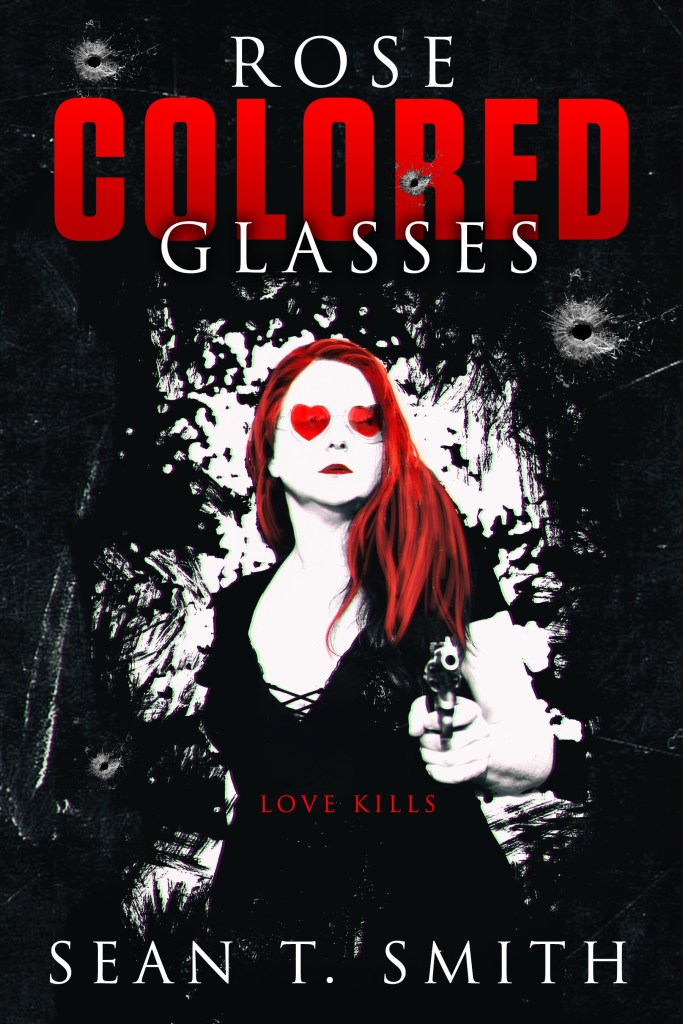
Rose Colored Glasses is now available in ebook and paperback.

https://www.amazon.com/gp/product/B0888T4RWP/ref=dbs_a_def_rwt_bibl_vppi_i0

For my fans, I’m sorry this took so long. I know some of you have sent me messages asking why I haven’t released any books in a few years.

There were two big factors. First, this was a very difficult book to write. It’s ultimately a love story as much as it is a thriller, and it centers around a failed marriage… something I’ve had intimate experience with. I struggled with how the book needed to end, writing many different versions of the last third of the book. I’m satisfied that it ended the way it needed to.

Second, I’ve been very busy with my day job as a solar consultant and my family. It’s been difficult for me to find the right balance of work, writing, and family. It’s a personality flaw— I tend to focus on only one of those things at a time, and when I do, other things suffer.

About the book—

My previous novels have been in some measure military thrillers, while this one revolves around only a few characters. This one also has some pretty graphic sex scenes and profanity, whereas the Wrath trilogy was squeaky clean.

I poured myself into this one, and there are certain things that cut close to the bone. I wrote large chunks of it while my wife and I were separated, so while the details of the book are vastly different from reality, there is a brutal honesty in the emotion.

What’s next?

I’m currently about 1/3 of the way through my next novel, the first in a planned trilogy. This one is more akin to the Wrath series. It will follow a family through three generations dealing with global wars sparked by climate change and pandemic, and in the final book, an American Revolution against what has become an autocratic, new-fascist government.

Thank you for reading!

I hope you’ll buy my book, leave me a review, and let me know what you think. I truly enjoy interacting with readers and discussing my books.

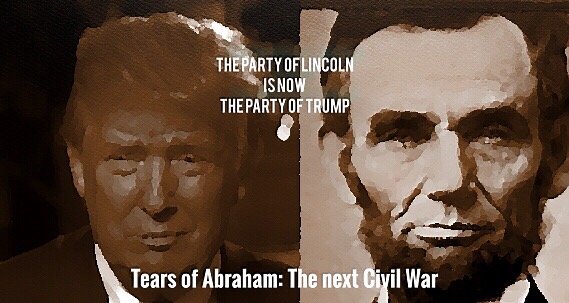
The party of Lincoln: Tears of Abraham

  
Lincoln is easily my favorite president, for without him the United States of America would not exist, and the world would be a vastly different place. We’d probably be speaking Russian and waiting in bread lines. Lincoln’s essential goodness propelled the nation to great heights. He was willing to shed blood to truly take America back. He freed the slaves with the Emancipation Proclimation and believed that our greatness lay in our unity.
Lincoln weeps among the stars as he watches Trump pander to the worst in us. Fear. Rage. Suspicion. 

Trump is unwilling to condemn David Duke, former Grand Wizzard of the KKK, and The Donald wants to outlaw an entire religion. The more offensive his is, the higher his ratings go. He is putting the Republican Party out of business. And conservatives know this.

Trump is surfing a wave of outrage, a tsunami of destruction and paranioa crashing into the country and smashing the nation. He won’t win the election. But he isn’t nearly as dangerous as the incoming wall of poision he’s riding. Because those waters won’t recede any time soon.

What happens after Trump looses the general election? Well, I wrote a book about that. Tears of Abraham releases March 22 2016. The first Civil War was bloody. The next one will be worse.

A Few Good Sentences

Readers often ask me about my creative process, so here’s a general snapshot of how I write.

I’m a slow writer compared to most of my peers. I’m not sure I could crank out a book in three months, and if I did that it would be unreadable. I know authors who crank out four good books a year. I’ll never have that sort of output.

It all begins with an idea

I tend to marinate on several ideas at once, before deciding what I’m going to write. I’ll make notes on legal pads, bar napkins, and the back of company notebooks. Once I’ve got a general idea of the topic, then I move onto characters. With Objects of Wrath,
I began with the idea of a family struggling to survive the next world war.

I sketch the main character first, and then surround him with the surrounding cast. Often at this point, I don’t know enough about the story to fill in the details, but I like to have a general idea.

Next comes the broad outline. This is only a few pages long, with enough space in there to add things. I use a legal pad, and I draw a diagram of a suspension bridge. The high points are the big scenes in the middle and the climax, and the lines in between are the rising action, the building tension. Sometimes I’ll actually use one full page for this diagram, and divide the rising action into specific chapter ideas. The point of this diagram is that I want to have a general idea of what I’m writing towards. It sounds simplistic because it is. But it is very helpful to me in terms of pacing.

The next thing I do is write a first chapter, just to get a feel for the characters. So far, a surprisingly big chunk of my first chapters have made it to the final manuscript. I go back later on and move things around, and work especially hard on the first fifty pages, but the bones are there.

Storytelling

I tend to plot out a few chapters ahead of time as I’m writing. For me this is the best part of writing books. I have notebooks crammed with ideas, where I just let things rip. “What if…” and then I’ll try that idea out, often in paragraph form.  One idea leads to another, and I’ll end up with various branching plot lines.

When I’m in this mode, I can write unfettered, and it is where I probably do my best work. It’s here that characters start to misbehave in good ways. A minor character becomes important, while a character that I’d planned on keeping alive has to die. I’ll stumble upon an idea that lights me up, and spend a few hours writing one paragraph working to get it right.

I alternate back and forth when I’m writing a novel, between storytelling mode, and the actual pounding out the words at the keyboard.

Here are a few random examples of paragraphs or sentences I worked very hard on.

From Objects of Wrath: http://www.amazon.com/Objects-Wrath-Volume-Sean-Smith/dp/1618682245

“I had seen Gunny in action, had been trained by him, and knew how quick and deadly he was, but Chilli was an artist in his prime form, painting death with deft strokes. With perfect economy of motion he dispatched a seemingly unending supply of enemies in an unrivaled masterpiece of destruction. I hacked and shot behind him through the smoke, and despite the chaos, I marveled at Chilli’s artwork. His canvas was the battlefield, and he was the Rembrandt of the knife, painting darkness, not light. He was the Picasso of the blade, leaving twisted corpses in his wake, his hands and feet brushes that flicked out almost delicately, precisely, colorfully”

From Children of Wrath http://www.amazon.com/Children-Wrath-Book-Volume/dp/1618683411/ref=pd_bxgy_14_img_y

“Most of us are blessed with a moment when sunlight is gold dust, warm and glittering, and the air is clean and tastes like hope. Sometimes we pay attention, savor the sweetness and are glad of it. Too often, we realize the rareness of it too late to revel in the glory of it. Looking back, though, we know the moment. That’s the yearning and the hurt later, because the memory is not the time, it is an echo. There is no way to feel exactly that way again, you can only recall the wholeness of it, remember the preciousness. My moment was long and my soul sings with the echoes I hear, but by the time we began our assault on Dugway, my moment had already passed.”

From Tears of Abraham, coming in March 2016

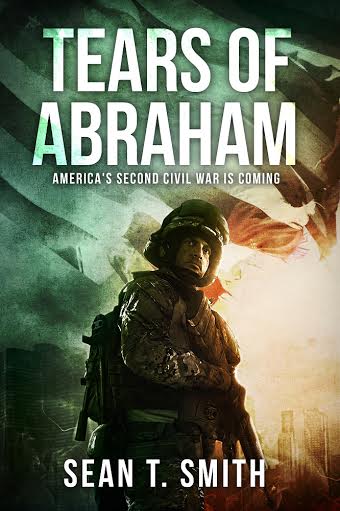
abraham cover final

“Stand up for yourself,” his father had said when Henry walked home with a bloody nose again. Henry’s old man, Tim Wilkins peered down at Henry. A tall, rangy man with a straight back, pale blue eyes, and a face worn out by life, Tim Wilkins was not prone to overt displays of affection or sympathy. But he was the center of Henry’s universe.
In Henry’s eyes then, his father was granite, solid rock, unbreakable, unchangeable, and strong in the way of a proud mountain. The lens of hope and faith filtered out the cracks and fissures, the broken blood vessels on Papa’s wind burned face, and the hurting eyes of a man eroded, but not yet completely worn smooth. Blasted by hard years, bad luck, and the love for the wrong woman, Papa remained undefeated.”

From Fate of the Fallen, my work in progress:

“Religion, Malak reasoned, would be at the heart of it. Money and power led to war between men. Religion could destroy mankind. Sometimes money and power were the religion, the worship of those things, by men who held armies on a leash. The worst of it was when money, power, and religion all combined. At the end of the day, it was always some kind of religion.”

Savoring the process

I love writing, whether it’s a song or a novel. I relish the entire process, and enjoy lingering over a passage, turning the words over, shifting things around to find a cadence and melody to the words. Some readers find this aspect of my writing a hinderence, and I understand that many folks want to read an adrenaline-driven book that’s primarily plot-driven. There’s nothing wrong with that, and I enjoy books like that  sometimes. The older I get, though, the more I want some real substance to the things I read and the things I write. I love Steinbeck, Hemingway, Dickens, McCarthy, Irving and O’brien. I’ve got a long way to go before I can attain that level, but that’s what I shoot for when I sit down to tell a story.

That’s my process, that’s my story, and I’m sticking to it!

TEARS OF ABRAHAM, cover reveal and signing announcement!

abraham cover final

The first Civil War was the bloodiest conflict in American history. The second war is worse.

While the nation tears itself apart, a soldier with a deadly secret fights his way home to his family.

Freedom is worth dying for, and love is a reason to live…but a house divided cannot stand.

Can Henry, Suzanne and the United States survive? Often the things we love we hurt the most.

Bestselling author Steve Konkoly says:

Tears of Abraham delivers a frightening look at a nation torn apart by a not so distant civil war. In classic Smith style, the conflict unfolds on a deeply personal level, delivering a guy punch of authentic military style action, sleek conspiracy undertones, and gripping family drama. I was hooked from the start by this uniquely dystopian military thriller.”

This is a deeply patriotic novel, my love letter to America. Should our differences lead to open war, the results will be beyond anything we can imagine, yet even now people clamor for secession without understanding what that would mean. While politics forms a backdrop to this book, it is essentially apolitical, a look at a conflict more than a hundred years in the making through the eyes of heroes, villains, and the innocent.

TEARS OF ABRAHAM will be released in March 2016, published by Post Hill Press and distributed by Simon & Schuster.