What if the Power Grid Goes Down in America

If you live long enough, you start to understand that the things we take for granted—light at the flip of a switch, water flowing from the tap, the hum of the refrigerator—are not guarantees. They’re conveniences balanced on a fragile lattice of infrastructure, politics, aging equipment, and wishful thinking. And every now and then, usually at three in the morning when the house is quiet and the world feels thin, I find myself asking the question most Americans avoid because it’s too uncomfortable, too real: What happens if the power grid goes down?

Not for an hour or for a day. But for weeks. Months.

The truth is, we’re not ready. We’ve built a civilization that runs on electrons, and we behave as if those electrons are eternal, ordained, and immune to failure. They aren’t.

Imagine the moment it happens. You’re sitting at home in Jacksonville, maybe watching the news or scrolling through your phone, when everything snaps off. The ceiling fan slows to a stop. The refrigerator clicks silent. The Wi-Fi dies. You wait for the power to return—because it always does. Except this time, it doesn’t. We’ve been through outages in hurricanes that last days, maybe a week but the power always comes back on. We trust that it will come on soon this time, but…

Within hours, the world begins to tilt. Because this time, it’s not just where you are, it’s everywhere.

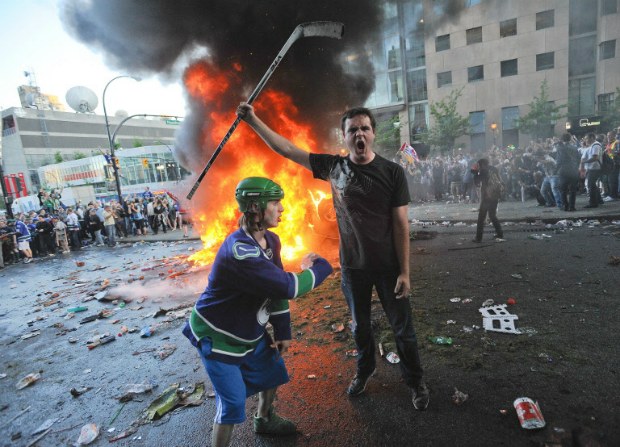
Traffic lights go dark, and intersections turn into games of chicken. Gas stations can’t pump fuel. ATMs don’t work. Your phone becomes a useless brick once the battery drains. Grocery stores stay open only as long as the daylight allows, and the shelves empty fast—faster than you think—because Americans panic with astonishing speed. And it’s cash only because credit card machines are down. Some stores accept checks for future payments, and the employees price gouge and line their pockets.

Within a day, the quiet becomes unnerving. We’re used to the background hum of civilization: HVAC units, cars, televisions, the constant buzz of electricity. When it’s gone, you hear things you forgot existed—wind through the trees, distant sirens, your own heartbeat.

By day three, the heat becomes a problem. Florida without air conditioning is a different world. People get desperate. Tempers shorten. The vulnerable suffer first: the elderly, the sick, the poor. Hospitals switch to generators, but fuel runs out. Medications spoil. Life-support machines fail. Food rots in fridges and the smell is death itself.

By day five, you start to understand how thin the veneer of order really is.

We like to imagine ourselves as rugged individualists, but most Americans don’t know how to purify water, cook without electricity, or navigate a world without Google. We’ve outsourced resilience. We’ve traded self-reliance for convenience. And when the grid goes down, that trade becomes painfully clear.

Communities fracture. Some band together. Others turn inward. Neighborhoods with strong social ties fare better—people share food, tools, information. Neighborhoods without them become dangerous fast. Darkness breeds fear, and fear breeds violence.

Law enforcement does what it can, but without radios, without fuel, without coordination, they’re fighting blind. The federal government tries to respond, but the grid is massive, interconnected, and aging. Repairing it isn’t like flipping a breaker. It’s like trying to rebuild a spiderweb while the spider is still crawling across it.

And then there’s the psychological shift.

When the lights don’t come back on, people stop waiting and start adapting. Some rediscover old skills—gardening, fishing, repairing, bartering. Others spiral. Civilization is a story we tell ourselves, and when the lights go out, that story changes.

But here’s the part most people don’t consider: America is resilient. Not because of our infrastructure, but because of our people. We’re loud, stubborn, inventive, and impossible to keep down. We rebuild. We improvise. We survive.

If the grid went down, it wouldn’t be the end of America. It would be the end of America as we know it.

The question isn’t “What if the power grid goes down?” The question is “What kind of person will you be when it does?”

Will you be the neighbor who hoards or the neighbor who helps? Will you be the one who panics or the one who plans? Will you be the one who clings to the old world or the one who builds the new one?

I write about collapse because it reveals character. Strip away the noise, the politics, the distractions, and you find out who people really are. And maybe that’s the point of asking this question at all—not to scare ourselves, but to remind ourselves that comfort is temporary, and resilience is a choice.

If the grid goes down, America won’t vanish. But it will change. And so will we.

The lights are on today. They might be on tomorrow. But nothing is guaranteed.

So ask yourself—quietly, honestly— Are you ready?
God and Post-Apocalyptic Fiction

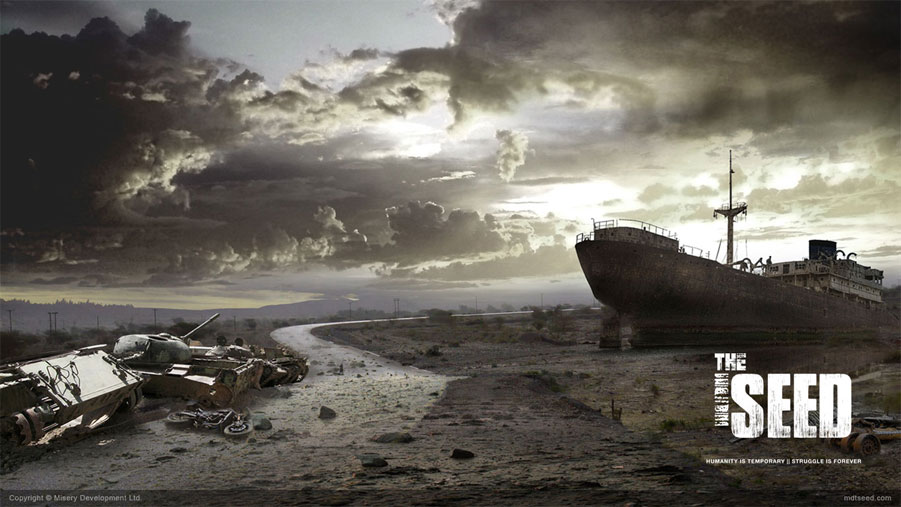
 wallpaper_preview_08

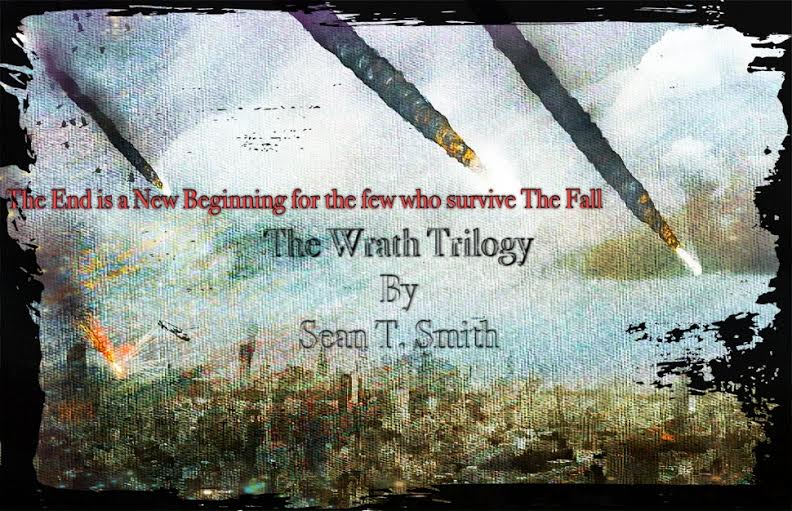
When the world is smashed and burning, I believe people will question why God abandoned us, while many who are not religious will turn to religion as a way of coping with the pain and destruction around us. Two of my favorite Post-Apocalyptic novels deal directly with faith: The Stand, by Stephen King, and A Canticle For Leibowitz, written by Walter M. Miller.  These novels both had a direct influence on my writing.

I’ve had a few reviewers attack the religious elements of my work, although the overwhelming majority of readers, both religious and agnostic, are not troubled by the way .the characters respond to the end of the world as we know it. While I wrote these novels from a Christian perspective, the books are by no means intended to be an extended sermon. Man has an innate need to connect to our creator, to find a way to explain our existence. Indeed, the idea of the apocalypse itself appears in Roman and Greek myths. The stories of the Biblical Flood and Armageddon go back thousands of years, and are a part of our collective human psyche.

wrathpic

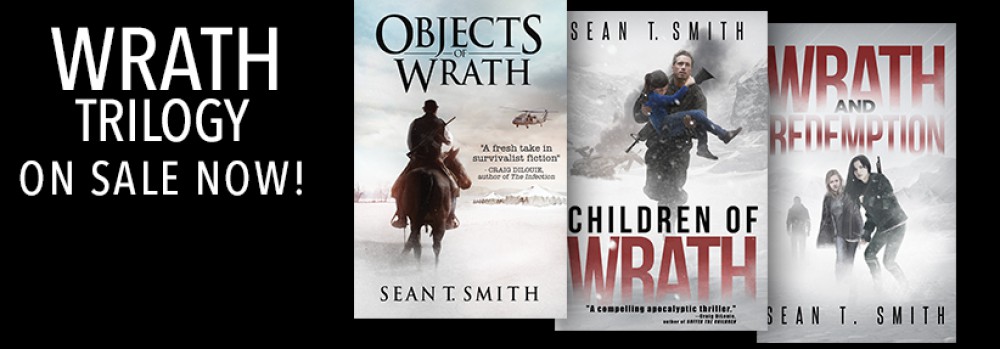
There is a reluctance now, it seems, for post-apocalyptic fiction to address religion. I wonder why that is? Are authors fearful of alienating readers? (This was certainly very much on my mind when I wrote Objects of Wrath.) Whether it’s zombies, a virus, an asteroid, or a war, the majority of PA novels delve into the questions of faith in a cursory manner. I’m not implying there is anything wrong with this approach, and certainly many survivors would not ask larger questions, being more concerned with finding food or fleeing the approaching hoarde.

When I read a novel or watch a movie, one of the things that keeps me interested are the questions, “what would I do? How would I react? How would that feel?” Whether it’s watching an epic battle from Braveheart and putting myself into the shoes of the men waiting for a thundering charge from heavy cavalry or reading the heart-wrenching scenes in The Road, where the father tells his son how to shoot himself. I contemplate the emotional impact, try to see and feel what the characters would be going through. In Saving Private Ryan, when the soldiers are coming toward the beach, rounds zipping through the water, bombs falling, what would that feel like, to have been one of those men? What would I do?

I’m certain that I’d pray. I’d question my faith, but I’d be simultaneously clinging to it. I think that’s how most people would behave. There are atheists in foxholes, but not many.

One of the  things about post-apocalyptic fiction which appeals to me is that it offers an unflinching examination of the human condition, a window into our essential being. When laws have disappeared and civilization is absent, what sort of people are we? Philosophers like Locke, Rousseau and Hobbs talk about our “state of nature” before the social contract. I love books that take a look at this question. It’s one of the reasons I enjoy The Walking Dead. While some novels offer a very dark outlook on humanity, in which most men are truly evil by nature, others are more hopeful. I think most people are decent and good, although evil is hungry and seductive. Can good defeat evil, even when it looks as though darkness has already won?

Religion can be a force for good or great evil. In my second novel, Children of Wrath, this is the central theme. Faith in and of itself is not always a good thing. There are atrocities being committed around the world even as I write, killing carried out in the name of religion. Whether or not one believes in any sort of God, there is no denying the way that religion has shaped our world. After the world as we know it ceases to be, people will still turn to the heavens, sometimes shaking their fists, other times begging for help.

Jamie Mason’s Guest Blog: Canadian vs. American Post-Apocalyptic Visions

Jamie 1

DEATH OF A NATION Canadian vs. American Post-Apocalyptic Visions

by Jamie Mason

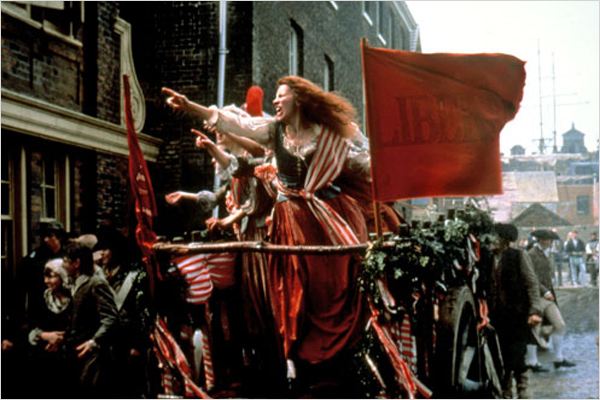
Broken windows stretch to the horizon. A noxious twist of grimy smoke clutches the clouds and a stench of bodies – the piled carnage of the City’s dead, an odor to corkscrew even the heartiest stomachs – lies heavily on the street. A door opens in a darkened shop-front and a man swathed in camouflage steps into view carrying an automatic rifle. The pearl-colored light reflects in his mirrored shades and the red, white and blue of his shoulder patch provides the only flash of color in an afternoon the hue of gun-metal and sorrow. A noise. He spins, bringing the rifle to bear … and is brought up short by the sight of a young, unarmed woman with a backpack slung over one shoulder, a maple leaf sewn into its pocket flap. She grins and flashes a peace sign. 1. The journey inevitably influences the traveller. But it is equally true that the traveler defines the journey. This is never more true than in the post-apocalyptic genre. One of my favorite films is the oft-overlooked 1985 gem REVOLUTION, starring Al Pacino. When Tom Dobb, the illiterate fur trapper Pacino plays, sails into New York Harbor on the eve of the War of Independence, he sums up the chaos unfolding in the streets tersely: “New York, goin’ crazy.”

jamie 2

The opening scene of that film confounds every expectation by painting the launch of the American Revolution with images of unimaginable brutality and human ugliness. Mobs smash British shop-windows, tear down statues of the King and (sadly for Tom) confiscate boats for the cause. Although history has vindicated the wisdom of the American Revolution as a critical step in the advancement of human freedom, I can’t help believing that the film’s portrayal is likely accurate. Strip away the historical bunting, and America was basically a colony that revolted against its landlords. Its birth was midwifed in a blaze of gunfire and death. War is war and, no matter how noble the cause, it’s always certain to unleash a level of apocalyptic violence. Canada’s birth was more ambiguous. We came into existence two short years after the end of the American Civil War, the result of a process that began in direct response to that conflict. By the time the British North America Act was passed, Canada was a sprawl of disconnected communities, ripe for annexation by a vigorous and ambitious neighbor. Invasions had been attempted five times in two previous wars and there was no reason to expect it wouldn’t happen again. (Indeed, a few of Lincoln’s generals lobbied for it.) Independence from a war-weary Britain seemed the most prudent way to secure the national welfare. Negotiations were lengthy and complex, tangled in British legal red-tape and impeded by competing colonial claims. Sir John A. MacDonald, our first Prime Minister, rose to lead a nation that was still very much unexplored and only just beginning to understand itself. Canada very literally emerged, blinking and uncertain, from the mists of the historical wilderness into a deafening silence.

Jamie3

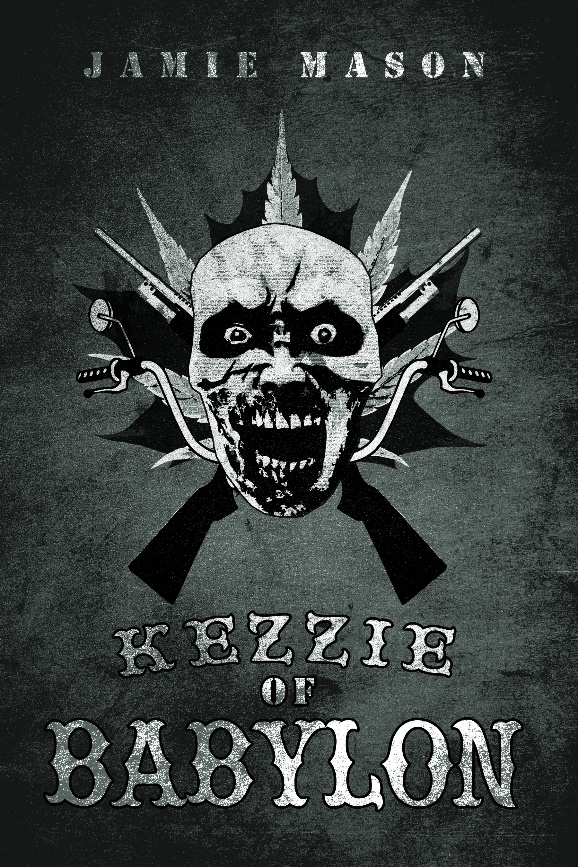
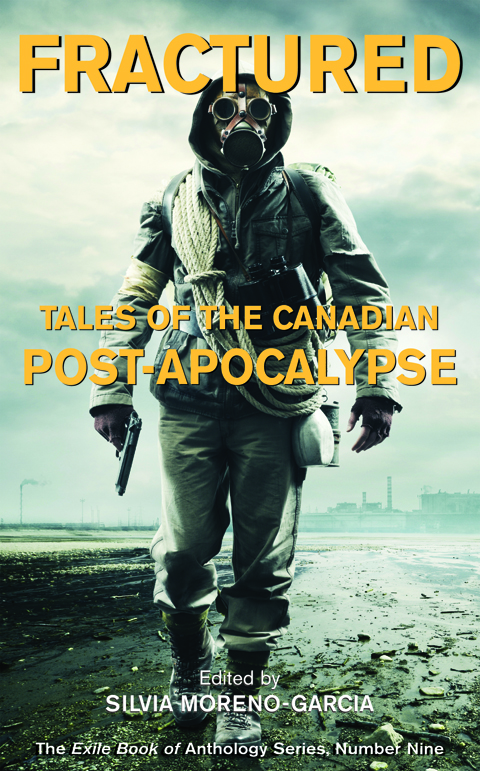
2. In our beginning lies our end. These two emergence narratives have served to shape, fundamentally, the contrasting American and Canadian visions of the post-apocalypse. I would hold that while television shows like THE WALKING DEAD and JERICHO and novels like WORLD WAR Z and THE PERSEID COLLAPSE portray a uniquely American apocalypse, Canadian equivalents such as ORYX & CRAKE, the collected stories of FRACTURED: TALES OF THE CANADIAN POST-APOCALYPSE and my own KEZZIE OF BABYLON (Permuted Press, March 2015) offer an equivalent Canadian vision unique in its own right. While there will always be an appetite for American entertainment north of the border, our American friends might be surprised to learn how our apocalyptic visions differ.

kezzie2

kezzie

3. ENEMIES & ANTAGONISTS Every good post-apocalyptic tale needs an enemy, and in American stories that enemy is usually a group or (in the case of zombies) a faceless horde which must be attacked and defeated militarily. THE WALKING DEAD handles this trope well, providing combat engagements pitting the protagonists against legions of zombies as well as human threats like the Governor and his dystopian serfs. WALKING DEAD s/heroes pack guns and katanas and these tools are always the go-to choice when trouble comes. This is not to dismiss other points of tension in the show (exploration, parlay with bad guys, character arcs), but to highlight the uniquely weaponized nature of the American post-collapse world. In a nation where the right to own firearms is enshrined in law and whose birth occurred in a storm of violence, it is logical that its death-throes would subside to the howl of gunfire. By contrast, the “enemy” faced by the main characters of Morgan M. Page’s poignant “City Noise” (FRACTURED: TALES OF THE CANADIAN POST-APOCALYPSE) is of an entirely different order. In Morgan’s vision, Toronto smoulders in the aftermath of a nebulous event known only as “The Crash” (an end every bit as ambiguous as our nation’s founding). The protagonists, Sarah and Johnny, are both transsexuals caught in the mid-point of transition when The Crash occurs, leaving them to scavenge in a blighted city for the drugs their bodies need in order to continue their biological migration. Instead of hordes of zombies to be vaporized by gunfire, the enemies Johnny and Sarah face are the ticking time-bombs of their own medically-altered biology, caught mid-way through a complex and transformative procedure

INDIVIDUAL VS. GROUP The cult of individualism is strongly rooted in the American consciousness and, for this reason, plays a titular role in any American post-apocalyptic story. The tendency for people to coalesce in a crisis is a historical given. But in American PA tales like OBJECTS OF WRATH (Permuted Press, 2014) the need for individualism sometimes leads to tragic results. One of the most poignant scenes in the novel involves a group of military first-responders flying into a remote encampment to offer aid to some backwoods survivalists. The unit’s doctor is turned away from caring for the group’s terminally-ill children because he is black. Here, hyper-individualism – the determination to survive with or without assistance from others, despite all logic – plays out in the ideology of a group existing in opposition to mainstream values of racial equality. Contrast this with the plot of my own novel, KEZZIE OF BABYLON (Permuted Press, 2015) wherein the Canadian tendency to seek accord and accommodation within groups – however dysfunctional – leads to disaster. A commune of biker outlaws, sheltered in the sanctuary of a remote grow-op in the hinterlands of Vancouver Island has, within its ranks, a deranged psychopath determined to impose her religious vision upon the group. The reluctance of the collective’s leaders to confront and disempower this person leads to murder, imposition of a form of worship that involves zombie crucifixion and (ultimately) destruction of the commune itself. Like those whose appeasement of the Quebecois nationalists resulted in the Meech Lake debacle, the reluctance of Buzz and Deacon to act allows Kezzie to take over and slaughter any who oppose her.

RELATIONSHIP TO NATURE Although environmental devastation often triggers the apocalyptic moment in American PA stories, it is rarely an ongoing threat as the plot progresses (THE DAY AFTER TOMORROW and Cormac McCarthy’s THE ROAD being the only exceptions that spring to mind). By way of final example, I contrast two short stories with the same title, one American, one Canadian. In Eric Del Carlo’s fascinating and brilliantly-rendered tale “The Herd” (OG’s Speculative Fiction, Issue #11), the Earth’s collapsing environment unleashes a series of devastating storms, driving a mass migration of human refugees ahead of them. Because I have spoken with Eric about the story’s origins, I can reveal that “The Herd” is based on his own experiences during Hurricane Katrina. Former residents of New Orleans, Eric’s family joined the stream of refugees clogging the highways just like the characters of “The Herd”. But it is what the storms cause people to do to each other as opposed to the storms themselves that form the real basis of Eric’s story. This in contrast to its Canadian counterpart. “The Herd” written by Tyler Keevil is first up in Exile Edition’s 2013 DEAD NORTH: CANADIAN ZOMBIE FICTION. In this unique twist on the zombie trope, Tyler presents us with a zombie horde migrating across the tundra, shadowed by an Inuit hunter. At play in this crisp, visually-evocative tale are all the elements of the classic Canadian wilderness survival story. It is Man against the elements as much as it is Man against … whatever. “A heaviness is in the air, a change in temperature, the wind, the look of the clouds. I know it is going to snow, and it comes in the early morning, just after the herd has set out. It arrives first, as a brief sprinkle … Then a lull, the air charged with a static crackle … Some of the deadheads stop, confused, and look up at this white confetti raining down …” – “The Herd”, Tyler Keevil, DEAD NORTH (Exile Editions, 2013) 4. And so we can see: the post-apocalyptic visions of both Canadian and American writers are informed by the human experience and social dimensions of the writers’ host countries. But it is in our origins, I think, that we find the defining characteristics of each country’s post-apocalyptic vision. We must remember that America and Canada are both nations engaged in the ongoing process of democratic evolution. Societies in both countries adapt to prevailing circumstances, learning from their mistakes, making mid-course corrections and each working to preserve the ongoing experiment that is any free society. We are unique, yes. But we influence each other enormously and are mutually fascinated by visions of the apocalypse. Americans, robust and individualistic, fight each other over possession of the wasteland while Canadians, willing to pay almost any price to remain within a group – however dysfunctional – seek to survive its ambiguous wilderness. As both nations emerge from history and grow toward self-actualization, we both imagine our own demise only to discover that we die very much the way we were born.

My friend Jamie Mason is a Canadian writer of dark fiction whose stories have appeared in On Spec, Abyss & Apex, White Cat and the Canadian Science Fiction Review. His zombie novel KEZZIE OF BABYLON was published in March of this year by Permuted Press. He lives on Vancouver Island. Learn more at www.jamiescribbles.com

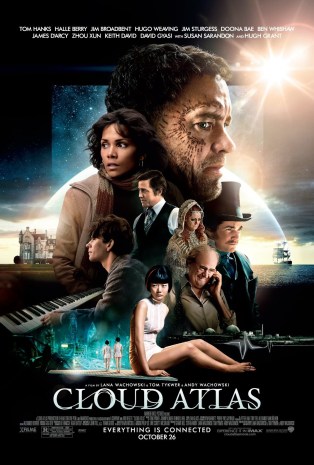
Coud Atlas… Review

I just finished watching one of the best films I’ve seen in years, Cloud Atlas. Some folks did not like the convoluted structure of the film, which features six story-lines over hundreds of years. After about twenty minutes, I was still confused, but glued to the screen. By the time the credits rolled, I did not want the film to end.

Image


The acting is perfect, with Tom Hanks and Halle Berry standing out in an ensemble cast. The film covers hundreds of years, with interweaving story lines and connections between each piece in history, from the mid-nineteenth century to the distant post-apocalyptic future.


I do not in any way believe in reincarnation, and you don’t need to in order to enjoy this movie, which is really about redemption, love, and freedom. The way our actions impact those around us, and how our decisions for better or worse can ripple through the generations.  The special effects were excellent, and not over-done in the way of most science fiction movies.


Every now and then, Hollywood surprises me by producing something cerebral and true; at a time when the box office is flooded by bombastic fluff and when the television is full of shows with zero substance, Cloud Atlas is like a cool drink of water on a hot day. It felt like I was reading a superb novel, layered and subtle, with engaging characters who grew over time.


I’ll be watching this one again soon.